(This article was first published on Instagram 06.11.2025
The Space Train
Lisää otsikkotekstisi tähän
The year is 2070. Humanity has built a fragile chain of stations between Earth, the Moon, and Mars — the first space railway. Each link in the chain glows like a tiny ember in the darkness. Ships refuel, exchange cargo, and send coded love letters across the network. No one travels faster than light yet — but they dream of it.
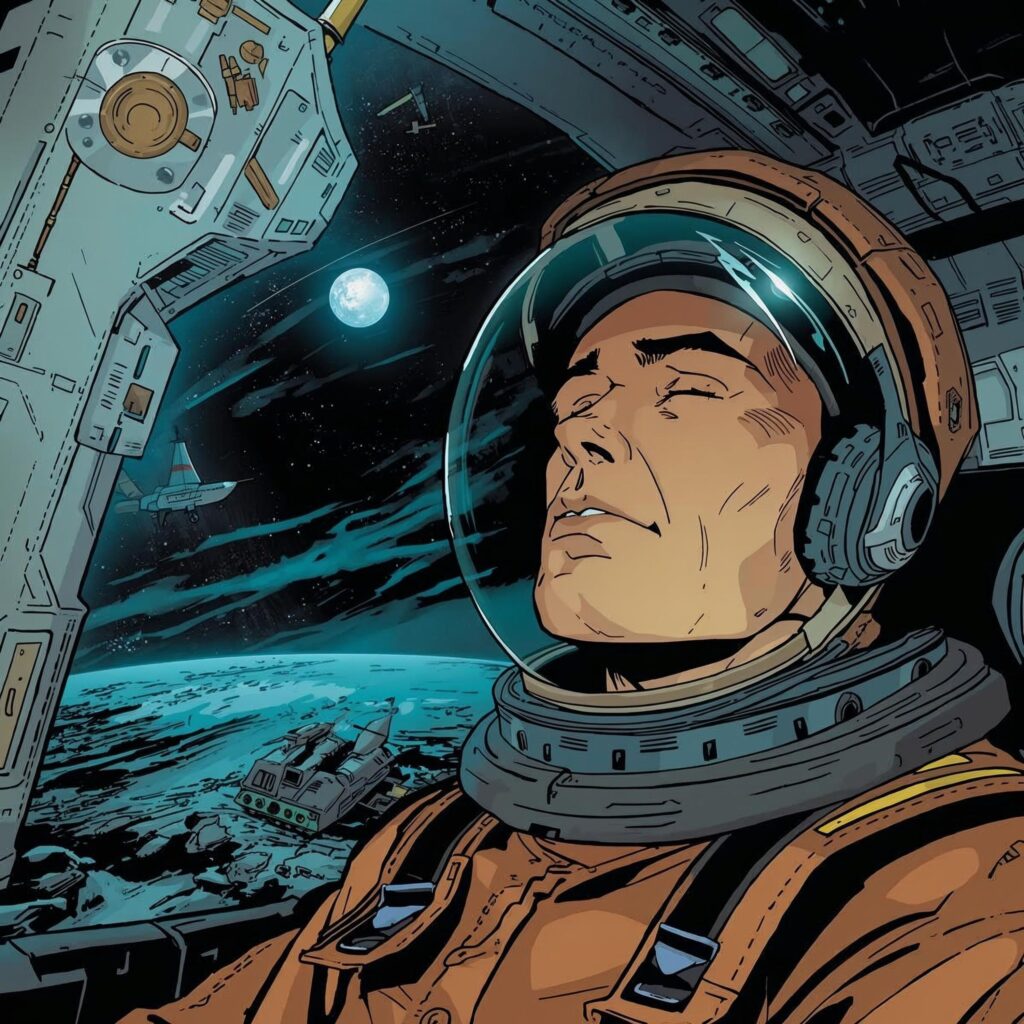
Captain Lucien Moreau stood by the viewport of Aurora Line 7, his reflection trembling in the glass as Earth fell away beneath him. The launch had been brutal — it always was, leaving the planet with the heaviest pull in the solar system. His hands still felt the vibration of the ascent, the slow burn that never quite let go.
“Welcome aboard Aurora Line 7, departing from Earth Orbit Station One.
Next stop: Lagrange 2 Hub.”
The announcement echoed softly through the narrow corridors. Lucien ran a hand along the metal frame — he could almost feel the history there. Aurora Line 7 wasn’t a passenger vessel in the old sense. It was a space train, a modular freight and personnel carrier connecting the growing chain of outposts between Earth, the Moon, and Mars.
Each stop was a fragile ember in the void — a small light blinking in blackness, a promise that humanity could stretch a little further.
At L2 Hub, he’d take on water and frozen ore from the automated miners.
At Selene Terminal, technicians bound for Mars would board.
By Station Hydra, half his cargo would be reactor parts and oxygen tanks bound for the colonies still struggling under the thin Martian atmosphere.
Between those points, there was only silence — the hum of oxygen filters, the rhythm of his heartbeat, and the faint crackle of the ship’s old music module.
Lucien liked to keep it running.
It made the darkness feel human.
He reached for the scratched metal cube on his console — A.D. was carved into the corner, by hand, with the precision of an engineer.
Anika Drexel, chief mechanic from Earth Orbit Dock 4.
She’d slipped it into his palm the night before departure.
“When you see Mars rise,” she’d said, “play the song. You’ll know which one.”
He did.
He always did.
Now, as Aurora Line 7 drifted past the curve of the Moon, Lucien pressed play.
The cabin filled with the soft pulse of analog synths — that dreamy warmth born from imperfect machines.
It was the sound of two people who had once shared the same gravity and now were separated by orbits.
Through the viewport, the stars shifted, slow and deliberate.
His reflection blinked back at him — a lonely figure inside a ship made of light and silence.
He closed his eyes, letting the melody fill the emptiness.
Outside, the Moon was already behind him.
Ahead lay months of travel, a red spark waiting in the distance — Mars, faint and patient, rising over the curve of space.
He thought of Anika’s last smile under the dock lights.
Her voice in the comms, low and clear:
“When you get there, don’t forget — play the bridge this time.”
Lucien smiled, though no one could see.
He increased the volume slightly, leaned back in his chair, and whispered:
“À bientôt, mon ingénieur.”
And as the ship slid deeper into the night,
the song played on —
a love letter carried by radio waves
through the endless chain of stations
between the stars.